Shopify + Amazon inventory management: how to stop overselling across channels
Shopify and Amazon each keep their own stock count with no automatic connection between the two. For many businesses, that results in overselling and stock outs. This post explains the structural reasons behind the problem and how to get both channels working from the same numbers.


Selling on Shopify and Amazon at the same time is one of the fastest ways to grow. It’s also one of the fastest ways to accidentally sell the same unit twice.
In Katana’s work with merchants running Shopify and Amazon simultaneously, preventing overselling is the single highest-priority operational problem – ahead of SKU mapping, multi-location tracking, and fulfillment automation.
Why overselling happens when you sell on both
When you run Shopify and Amazon separately, each channel has its own inventory count. You start the week with 50 units. Shopify shows 50. Amazon shows 50. But you only have 50 – not 100.
A Shopify sale needs to immediately update Amazon’s available stock. Without that, Amazon keeps showing 50 and keeps accepting orders until someone manually adjusts the count – by which point you’ve already sold units you don’t have.
The core problem is two channels sharing one pool of physical stock with nothing keeping the numbers in sync.
A few things make it worse:
Order timing: Amazon and Shopify orders don’t arrive at convenient intervals. A spike on one channel can clear out stock before the other channel knows anything happened. Flash sales, promotions, or a well-placed review can empty a SKU faster than any manual process can track.
Fulfillment routing: Some orders go through Amazon FBA, some ship from your own warehouse. FBA stock and warehouse stock counted as a single pool makes it easy to commit the same inventory to both channels.
Manual updates: Teams logging into two dashboards and manually adjusting stock introduce human error at every update.
What happens when you do oversell
It’s worth being clear about the cost, because it goes beyond a cancelled order.
On the customer side: the buyer gets a cancellation or a delayed shipment after they’ve already paid. That’s the kind of experience that earns a one-star review and rarely gets a second chance.
On the Amazon side: for FBM sellers – where you ship orders yourself – overselling directly affects your Pre-Fulfillment Cancellation Rate, a separate account health metric from Order Defect Rate. Amazon requires sellers to keep that rate below 2.5%; above it, seller-fulfilled offers can be deactivated. FBA orders work differently: Amazon controls the stock, so running out simply makes the listing unavailable rather than generating a seller-initiated cancellation. Either way, protecting your inventory accuracy on Amazon is protecting your ability to sell there.
On the Shopify side: overselling is harder to recover from than running out of stock. When a customer pays for something you can’t deliver, the cancellation and refund both land on your team – and rebuilding that customer’s trust takes serious effort.
Three ways to cut overselling down
1. Keep your Shopify and FBA stock separate
The simplest structural fix is treating FBA inventory and your own warehouse stock as separate pools and only selling what each location really holds.
With 200 units total and 80 in FBA, Amazon draws from those 80 only. Your Shopify store draws from the remaining 120 in your warehouse. Neither channel can commit inventory the other is holding.
The goal is assigning stock to specific locations and selling from each location’s actual count.
For merchants also selling through FBM (Fulfilled by Merchant) on Amazon – where you ship orders directly from your own warehouse – the stock picture gets more complex. FBM and Shopify orders are drawing from the same physical location, which makes a centralized inventory system even more important. Without one, FBM and Shopify can make competing claims on the same stock.
2. Set channel stock buffers
Even with separate location counts, high-velocity sales can outpace sync speeds. A stock buffer is a simple way to protect against that.
Instead of making all available stock visible on each channel, you hold back a small reserve. With 50 units at a location, showing 45 as available leaves a 5-unit cushion to absorb any lag between a sale and a stock update.
The right buffer size depends on your order velocity and how frequently your channels sync. A brand doing a handful of orders a day can work with a buffer of 2–3 units. A brand running regular promotions or selling in volume might want 5–10% of available stock held back per channel. Start conservatively and adjust based on how often you’re actually cutting into the reserve.
3. Sync inventory from one central place
Both of those measures help, but they work best when both channels are drawing from the same source of truth rather than maintaining separate counts that need to be reconciled.
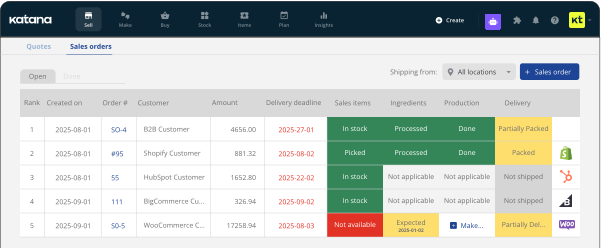
When Shopify and Amazon connect to a central inventory system, a sale on either channel immediately updates the shared stock count. Both storefronts reflect accurate availability. There’s no manual reconciliation, no lag window where one channel is selling units the other has already committed.
This is what Katana’s Shopify integration and Amazon integration are built to do – keep stock levels accurate across both channels from one place, so you’re not managing the same numbers in multiple systems.
A note on Amazon FBA specifically
FBA adds a layer of complexity because Amazon controls the inventory once it’s in their warehouse. FBA units can’t cover a Shopify shortfall: once stock is in Amazon’s fulfilment centre, Amazon controls it.
Treat FBA inventory as reserved for Amazon orders, and keep enough stock in your own warehouse to cover Shopify (and any other channels you’re selling through). When FBA stock drops to a reorder threshold, replenish it as a separate purchase order to FBA, keeping your warehouse stock available for other channels.
Katana tracks FBA and warehouse stock separately, with reorder points per location and a single view across both. Details on how the Amazon integration works are here.
FAQ: Selling on Amazon and Shopify
Yes, provided both channels are connected to a single system that updates stock in real time. Shopify and Amazon managed separately each maintain their own stock count, and they don’t communicate with each other. A central inventory tool that both channels feed into and draw from is what keeps the numbers accurate.
Start with location-based stock separation: FBA and warehouse counted distinctly, so neither channel can commit the other’s inventory. Add per-channel buffers to cover any sync lag. Then connect both to a centralized inventory system. Each addresses a different layer of the problem, and they work best together.
Only with a direct integration or inventory management tool connecting them. Without that connection, each platform manages its own stock count independently. Setting up a Shopify–Amazon integration is what makes stock updates automatic across both.
Get inventory trends, news, and tips every month
Explore all categories
Get visibility over your sales and stock
Wave goodbye to uncertainty with Katana Cloud Inventory — AI-powered for total inventory control