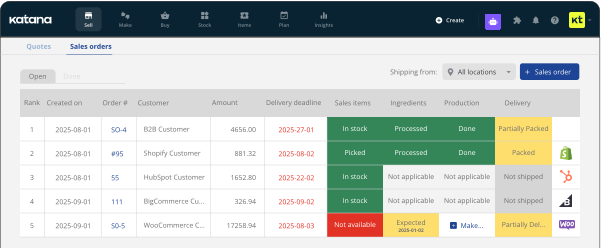
Why they switched: How real SMBs swapped old systems for Katana
Six short switch stories from product businesses: what pushed them off spreadsheets and outdated tools, and the setup changes teams made to get inventory management under control with Katana.


What makes a product business change its inventory management tool? If you’re reading this, you probably have a few ideas.
Orders are coming from more places, and stock is spread across more locations. Eventually, the current process stops working. Spreadsheets can’t handle the volume, or a system that worked at 200 orders a month creates errors at 2,000. Usually, a specific event, like a new sales channel, a second warehouse, or a bad stockout, makes it clear you need to switch.
In the stories below, you’ll see real businesses that reached their limit, the setup changes they made to get a process they could rely on, and how Katana supported the transition.

Case 1: No system for inventory work and $40K sitting unused
Industry: Apparel manufacturing
Found Surface runs small-batch custom garment production for emerging brands. As the business moved from operating like a fashion brand to running full-service manufacturing, their day-to-day work was still held together with manual tracking and undocumented workflows.
The problem:
The company didn’t have a dedicated system for inventory or production, which made it hard to see what materials they had, what was committed to customer work, and what was ready for production. They also lacked a set process for quoting and sampling, so customer projects were harder to run the same way every time.
Expansion plans, including a move to a 20,000 sq. ft. facility and major new equipment purchases, made a system that could act as an operational backbone urgent – so they went looking for one.
The setup:
They used Katana to run quoting, sampling, and production in one place.
With Shopify connected and QuickBooks Online used for accounting, customer orders, production work, and financial records stayed aligned. They tracked materials in a way that tied raw materials to specific customers and orders, and used guided onboarding so the team could run the system on a day-to-day basis.
Quoting + sampling + production in one place • Shopify + QuickBooks Online connected • Materials tied to customer work

Case 2: Stockouts and overselling during demand spikes
Industry: Handmade home décor
Unwilted sells made-to-order paper floral arrangements through their Shopify store. As demand grew, their inventory setup couldn’t keep up: stock updates would lag, which meant they could sell items without a clear view of what was available.
The problem:
Before switching, they were relying on a mix of disconnected tools: Shopify for ecommerce, QuickBooks Online for accounting, a previous (outdated) inventory management system, and spreadsheets for production coordination.
As volume increased, that setup made it easier to sell items they couldn’t fulfill. Bills of materials sat separately from stock on hand, and inventory updates didn’t always happen when they needed them, and they ended up overselling and cleaning up issues after the fact.
The setup:
They started tracking raw materials and semi-finished stems in Katana and linked them to finished bouquets with multi-level BOMs, so they could see what they could make from the stock they had.
With Shopify orders flowing into the same system and QuickBooks Online connected for accounting, sales, purchasing, and production planning worked off the same source. Automatic Shopify inventory sync helped prevent overselling during demand spikes.
Multi-level BOMs • Shopify inventory sync • Sales, purchasing, and planning working off the same source
“Things would be wrong, or the Shopify sync wouldn’t update for 24 hours.”
– Liz Carter, Founder at Unwilted

Case 3: Manual updates across channels and 30+ hours lost each week
Industry: Sporting goods
Mine Baseball sells wood bats online. As they expanded across Shopify, Facebook Shops, Etsy, Google Shop, and Amazon, their team was managing more orders in more places while trying to keep stock and shipping work consistent, especially heading into their busiest season.
The problem:
They were dealing with two problems at once. They often had too much of the wrong product and not enough of the right one. Because nearly half of annual sales happening between May and July, inventory misreads during peak season were hard to recover from.
They also had a lot of manual work. Shopify was the main system, but inventory levels across other channels had to be updated by hand. Shipping was manual too and disconnected from Shopify, which meant extra steps just to keep orders moving and stock levels accurate across channels.
The setup:
They centralized inventory in Katana, pulling order data from Shopify and pushing inventory updates across platforms so stock stayed current across channels. For fulfillment, they connected Shiptheory so Shopify orders could flow through and shipping labels could be generated without manual input, cutting repetitive admin work.
Central inventory in Katana • Inventory updates pushed across channels • Shipping labels generated via Shiptheory
“Katana allowed us to consolidate everything into one platform. We know what our inventory is at the central hub, and it pushes out to every other location.”
– Lance O’Brien, Chief Operating Officer at Mine Baseball

Case 4: Peak-season volume made warehouse stock hard to trust
Industry: DTC home goods
This brand ships through Shopify and runs aggressive promos (including “Buy One, Get One”). During the holiday rush, they were onboarding Katana while managing multiple warehouses and a flood of orders. They wanted better inventory visibility than spreadsheets could give them, without disrupting what customers saw as available on the site.
The problem:
Inventory was moving between locations so often that it was hard to keep a clear picture of what was where. Shopify could move inventory into their main shipping warehouse automatically when it ran out, while the team was also doing manual transfers. That combination could lead to moving too much stock and mismatched counts.
Promos made it worse since it was hard to determine which SKUs customers would pick, and their main warehouse didn’t have space to hold enough inventory for a big sale. They also needed an inventory aging report for audit questions, and they were still doing some inventory value work in Excel, rather than a dedicated inventory management tool.
The setup:
They used Katana to manage purchase orders and receiving, so incoming stock updates were captured as soon as items arrived. They also used it to keep orders and stock organized while inventory moved between locations during the promo period, with the next full stock count as the reset point for getting quantities aligned across locations.
Purchase orders + receiving captured on arrival • Stock kept organized across locations during promos • Stock count used as a reset point

Case 5: Currency and landed costs made the old costing process unreliable
Industry: Agri-tech
This greenhouse business ships globally, with items built from components sourced in bulk overseas and assembled in the UK. They move stock to different parts of the world as demand changes. As shipment volume increased, they needed a clearer way to track what they had and where, and the accumulated costs. They wanted to cost inventory in USD and keep track of what each unit really costs after purchasing, labor, and shipping.
The problem:
Costing was where things started to break down. Purchases and sales happened at different exchange rates, so month-end conversions didn’t always match how the inventory was bought. Once stock started moving between locations, shipping costs changed what items cost in each region. It took a lot of manual work to keep margins and pricing based on numbers they could trust.
The setup:
They implemented Katana to cost inventory and manage stock across locations. They track purchase and sales activity in multiple currencies, while keeping Katana set to their group reporting currency (USD) so internal costing and pricing stays consistent. With inventory movements and costs tracked in the same system, the team can see where stock sits and what it costs without rebuilding the numbers by hand each month.
Multi-currency purchasing and selling • Costing kept consistent in USD • Stock and costs tracked across locations

Case 6: A stockout cost a major customer (and forced emergency shipping)
Industry: Ingredients and extracts
This extracts business was picking up speed, but their inventory tracking was struggling to keep pace. Because they were still updating stock by hand across different tools, the team never quite knew if they had enough stock to cover a big order without physically checking.
The problem:
Manual inventory entry didn’t scale. They had a stockout that cost them a major customer, and they had to cover emergency shipping to protect other orders. On top of that, the lack of a dependable view across manufacturing and purchasing made it easier to tie up cash in dead stock, instead of ordering what they actually needed.
The setup:
They implemented Katana so inventory stayed connected to manufacturing and purchasing. That cut out ongoing manual data entry (over $14,000/year) and gave them a more dependable way to plan inventory and production before they hit another stockout. With a clearer picture of what was coming in and what was being made, they could reduce emergency shipments and prevent $2M in capital from getting stuck in dead stock.
Inventory tied to manufacturing + purchasing • Less manual data entry • Fewer emergency shipments + less dead stock
Sounds familiar?
If you’re looking for a better way to manage inventory and keep stock in sync with online orders, purchasing, and production, try Katana’s Free plan.
Connect the tools you already use and get a first look at what the ideal setup can look like for your business.
Get inventory trends, news, and tips every month
Explore all categories
Get visibility over your sales and stock
Wave goodbye to uncertainty with Katana Cloud Inventory — AI-powered for total inventory control