
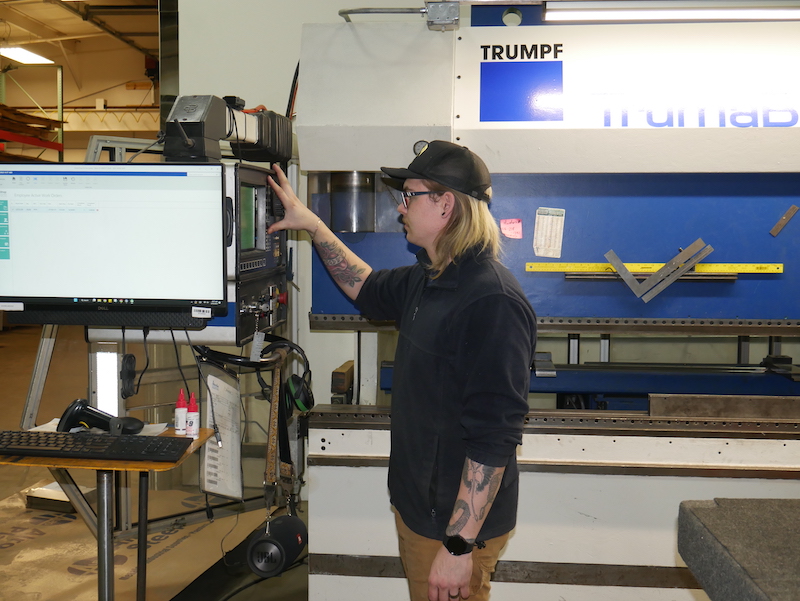
How Shoreline Manufacturing replaced $80,000 a year in workarounds with Katana
Shoreline Manufacturing, a contract metal fabricator in Michigan, needed a system personalized to how their shop runs. The Katana team scoped every workflow with them, built it to fit, and checked it with their team before go-live, less than two months after kickoff.
Over 99%
faster material ordering and 120+ manufacturing orders in the first 3 weeks
Personalized system
live in under 2 months
Website
Integrations
QuickBooks Online
Industry
Contract metal fabrication
Location
Holland, Michigan, US
About Shoreline Manufacturing
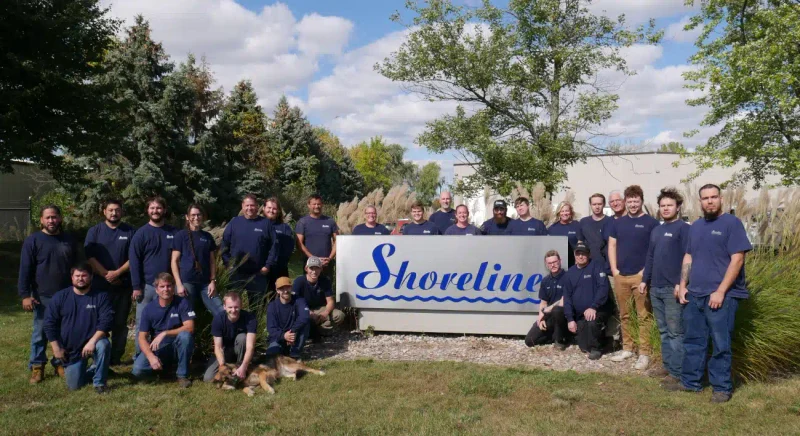
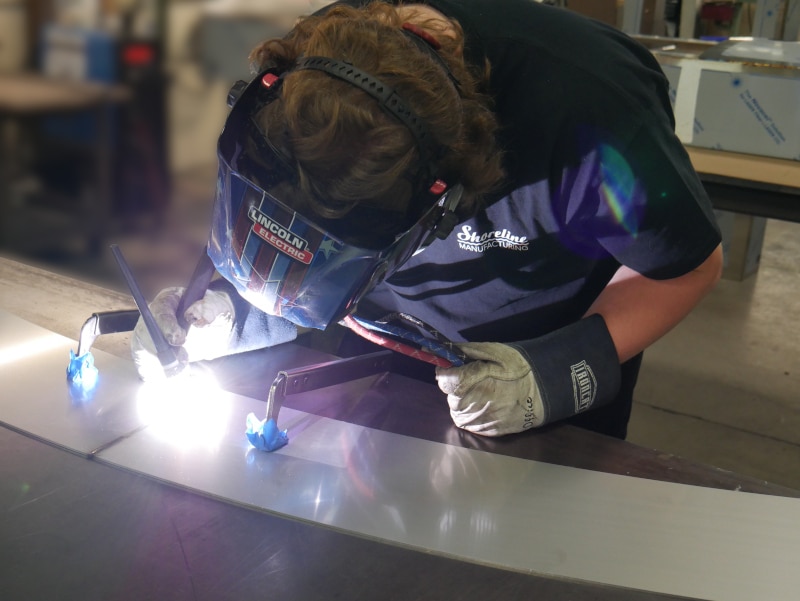
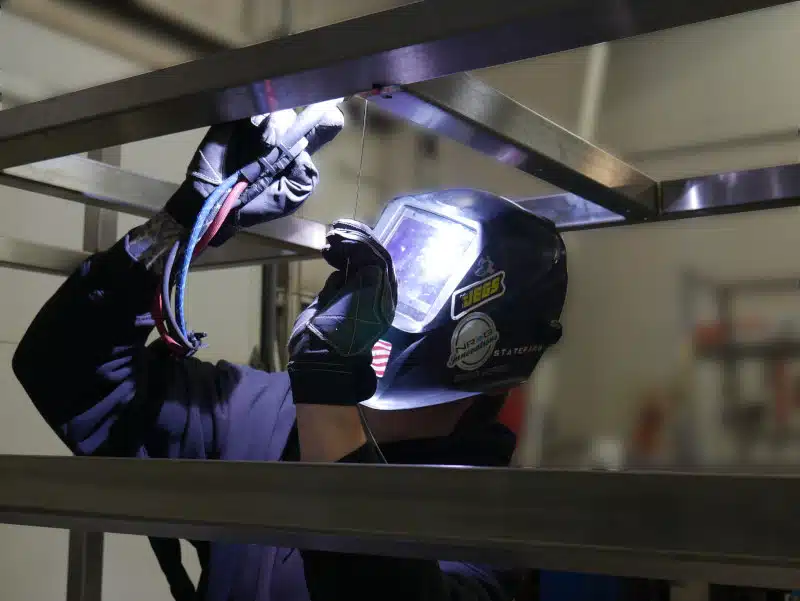
Ryan Fogg started Shoreline Manufacturing in 2006. Today, 50 team members process manufacturing orders across a diverse customer base out of the 100,000 sq. Ft. Holland, MI facility.
Alongside steady orders ranging from a few hundred to hundreds of thousands of parts, they also have several products of their own that have been derived from years of manufacturing experience. Their in-house capabilities include engineering, prototyping, and manufacturing. This wide range of abilities means that managing a flow of projects across multiple resources and team members effectively is non-negotiable.
When Ethan Lemmen joined as Vice President about a year and a half ago, coming from NetSuite, it took him less than a week to see that Shoreline’s ERP was holding the business back.
The challenge: an ERP the team had to work around
Shoreline was “held hostage by the ERP,” as Ethan puts it. The old system was slow and server-based, but the main problem was that nothing in it was connected. Each step of an order lived in its own module with its own training, so each step needed its own owner. Engineers spent their days setting up parts and bills of materials because nobody else could make the system work.
“We were trying to force projects whose time, quality, and cost depended on our throughput efficiency through a disconnected, non-intuitive system. We were chasing false precision with good intentions, but in the end, we were left with a lack of all the things we desired from an ERP. We had no quick access or project-level visibility. The questions floating around the shop and office daily revolved around things like “Where are the parts for this job? When is it due? Who’s working on it? Have you heard when we’re cutting that on the laser? I’m waiting on parts,” Ethan says.
Most of the team found it easier to work around the ERP than with it. They tracked jobs on paper and in Excel, then typed everything back in afterward because that was “the human-chosen path of least resistance.” For Ethan, that was the clearest sign the system wasn’t working, and more training wouldn’t change it.
You can say more training till the cows come home, but you never get true adoption if it’s not intuitive. People creating workarounds is your evidence that it’s not intuitive.
Ethan Lemmen, Vice President, Shoreline Manufacturing
Purchasing was where the delays piled up. Given the nature of project-based work, Shoreline buys material per job to avoid tying up cash in inventory. Working out what to order could mean up to three days in separate nesting software before anyone built the purchase order by hand and called it in. Material then took up to a week to arrive, so many jobs ended up delayed. Keeping records straight after that was just as much work.
“We had this kind of foolish pursuit of clerical excellence that probably cost us $80,000 a year. [We were] auditing time cards, editing BOM, modifying invoices, tracking stuff on paper, and manually keeping track of things in Excel and writing it back into [our old ERP]. It was just crazy.”, said Ethan.
The system never held a job’s full plan in one place. Details moved from person to person by word of mouth, and nobody could see the whole job or take ownership. Ethan recalled a run of powder-coated stainless steel planters for a hotel that bounced between people like a “hot potato” and went wrong almost every step of the way. Shoreline put about $100,000 into a job sold for $70,000, and it still shipped late.
Why Katana: a system the whole team can run
Shoreline compared several systems. Poor adoption had been one of its biggest problems, so after watching the team work around the old ERP, Ethan’s “main success criteria” for a new one was a system that was “really intuitive,” and Katana answered each of their problems directly.
| With Katana | With the old ERP |
|---|---|
| One connected workflow from quote to purchase | Separate modules that didn’t share data |
| Anyone who learns the flow can run a whole job | A trained specialist for each step |
| Cloud-based, with most actions a click or two away | Slow, server-based, with a new screen for every action |
| Each job’s materials and operations in one place | Jobs tracked on paper and in Excel, then typed back in |
| Custom builds scoped and delivered with the Katana team | Paid customizations, with weeks to get a price and 6 to 8 weeks to build |
With the old ERP, even simple tasks got lost between screens. “Everything popped open in a new screen. You’d wait for that screen to load and forget what you were doing,” Ethan says. “In Katana, if you want to sell something, you click a button that says sell. It just makes sense. And if you’re looking to grow your business, you need to make the foundational tasks feel EASY. We had people waiting in line for Packing Lists, trying not to stress out the guy processing completed work orders. It would take half an hour to get a paper packing list to take with a delivery.”
To make Katana fit its needs exactly, Shoreline got a dedicated team to build customized workflows, like due dates that follow each customer’s order and material bought for every job with a clear trail back to it.
Ethan Lemmen, Vice President, Shoreline ManufacturingWe were really clear-eyed about what our needs were. Katana was really receptive to saying we can customize things to make it fit your business, rather than here’s the solution in a box.
A system scoped and built around Shoreline’s shop
Ethan’s needs list was built and in place before go-live.
- Due dates that follow the sales order. When a customer’s date moves, every linked manufacturing order moves with it. This was Ethan’s top priority.
- Buy to Order. Purchase orders are generated from a job’s materials, grouped by supplier, and carry the sales order reference. This way, raw materials can be grouped by project, and people are not searching for parts.
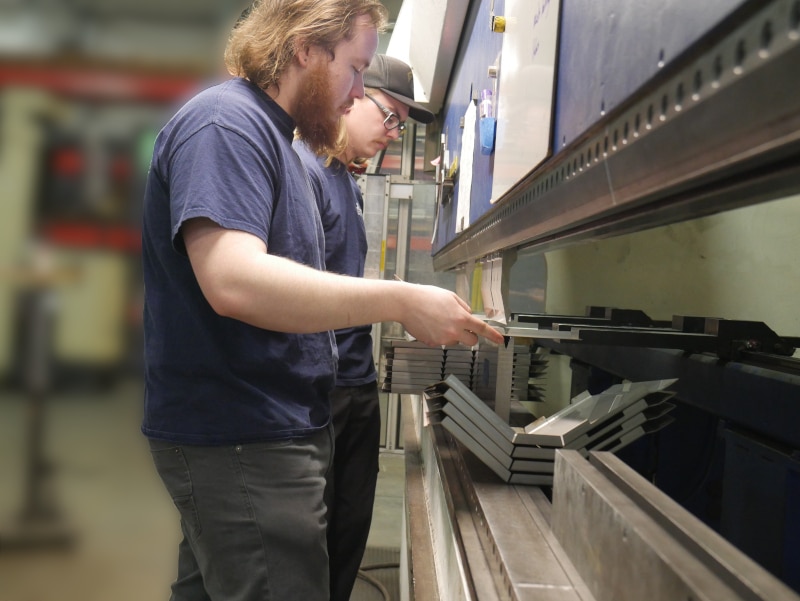
- Notes on each operation, visible to the shop floor, including unique due dates for each operational step. For example, in his world, it was very important for laser to have a due date preceding brake press, and for brake press to precede fabrication.
- A scheduling calendar with a due date for every operation, and true backward-scheduling capability. “In our industry, inability to hit lead times equals losing out on work, so we always backward schedule. Start at the answer and work your way back to be successful.” The calendar helps the team with scheduling logistics, as well as forecasting. It enables Ethan and his team to spot bottlenecks before they occur, and level-load the production schedule.
The calendar surprised Ethan most. His Solutions Engineer asked so few questions it “almost made him nervous” he’d missed something critical. Just four weeks later, the calendar arrived with extra features Ethan hadn’t asked for, drawn from the engineer’s manufacturing background.
The type of collaboration we’ve gotten so far has been fantastic. They leveraged their experience to build in features they knew we’d need, in anticipation of the pinch points we might face.
Ethan Lemmen, Vice President, Shoreline Manufacturing
With the old ERP, every change was a paid project. Ethan needed two weeks of calls just to get a price, then the work waited six to eight weeks in a development queue. With Katana, Shoreline’s team gets direct support by email or phone and either customizations built for them or help to do it themselves.
Capturing necessary changes while the problem statement is still fresh is usually the most effective way to improve the process. When things go into a queue, they lose momentum, and team members develop workarounds and form inconsistent habits, which ultimately hurt the business.
With Katana, I feel like we can implement those necessary changes on the fly as we grow as a business, knowing that if we can’t figure it out on our own, we’ve got the support system to fall back on.
Ethan Lemmen, Vice President, Shoreline Manufacturing
Beyond what the team built, Katana’s MCP let Ethan connect ChatGPT, which he’s leveraged to draw insights that would have previously required time, people, and spreadsheets.
“I can instantly view my laser backlog. I can pull on-time or quality metrics at any given time. I can mass update the routings for products in Katana using Chat. I can create forecasts at the drop of a hat. I can track trends in customer revenue. I can track trends in COGS. I can review workload and capacity for any operation, resource, or team member and derive key insights or deliver performance feedback. I have a short form set up in Chat that automatically generates part numbers so we have a consistent nomenclature, then creates them in Katana. I have it send email alerts to different team members for things like PO follow up, margin awareness, actual vs. Planned reporting, and more. The list goes on and on. Anything you ever wanted to know, or do quickly, is now possible without assigning work.”
It’s allowed us to shift our focus from “What data do we need, how do we gather it, how should we formulate it?” To “What action is our data telling us to take, and how do we act on it most effectively?”
Ethan Lemmen, Vice President, Shoreline Manufacturing
Results
Live in two months, with the whole team on board
- Shoreline went live on October 1, less than two months after kickoff, with its custom-built system in place.
- The process that used to be split between specialists now runs end-to-end, and three people on the team are already trained to take a job from quote to purchase.
- In its first three weeks, Shoreline ran more than 120 manufacturing orders through Katana.
- Material can be ordered for a job within 2 minutes of creating the work order, so jobs aren’t starting behind. The team uses that time to procure raw goods in a cost-competitive manner.
- Visibility of work in progress lets them communicate with customers in a proactive way.
- With every job’s plan in Katana, the team no longer relies on word of mouth to pass work along. That’s changed how they work together.
It’s changed the culture of our business. We don’t have to tell the story to move the information through the physical production process anymore. It’s become a data-driven actionable system and it’s extremely productive.
Ethan Lemmen, Vice President, Shoreline Manufacturing
What’s next: ready for takeoff
Seeing profitability job by job has already changed what Shoreline focuses on. The team assumed custom fabrication was their strongest work, but “we actually do a lot better on simple laser and bend stuff,” Ethan says, and sales is now going after more of it.
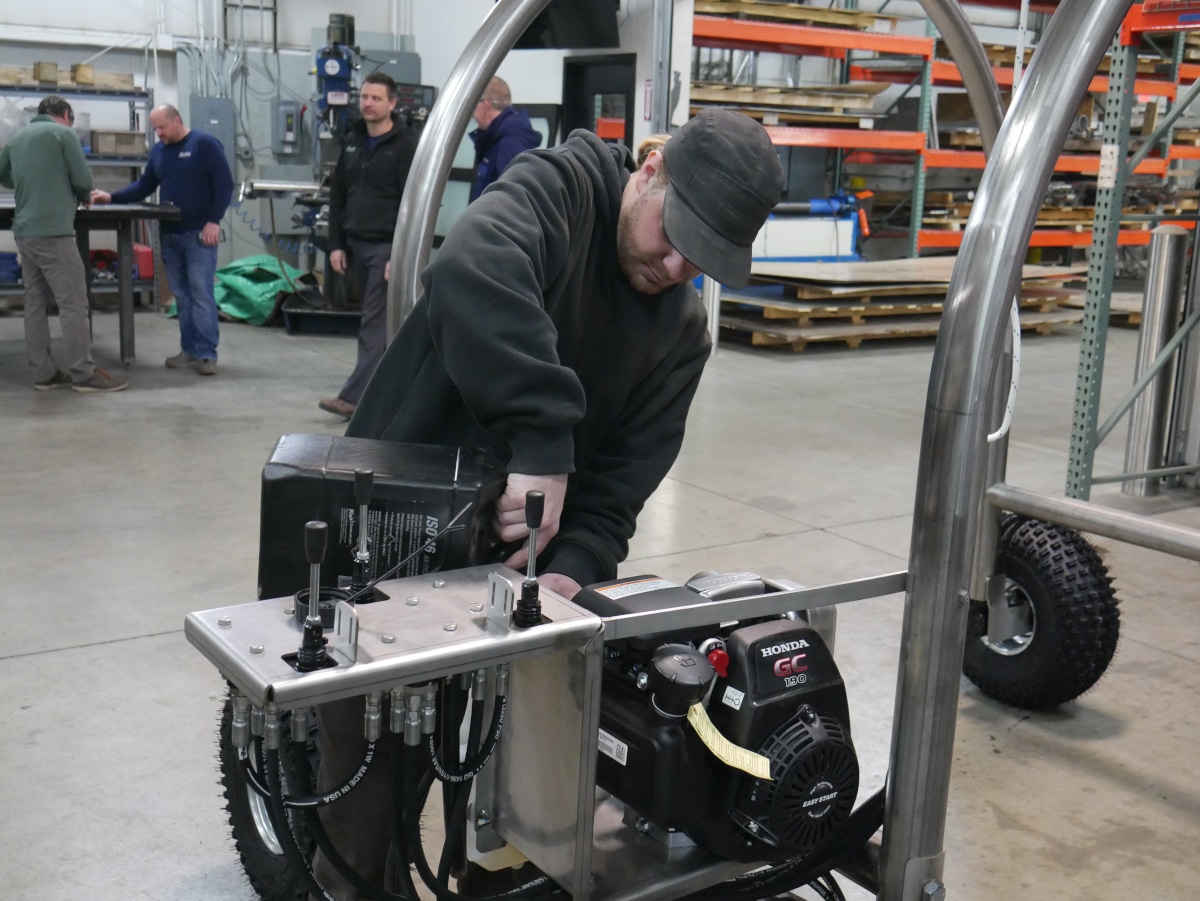
The product side is next. Shoreline’s ground support equipment for regional airports never scaled because the team couldn’t track and build it cost-effectively. Now that they control their bills of materials and purchasing, Ethan and Ryan are planning to expand it.
“It makes me more confident to pursue a larger product line…I’m confident we can do that now so we can aggressively target those markets and develop those products in a way that it wouldn’t have really made sense to without the right tool.” says Ethan.
For him, it’s personal too. He can check on the business from home, whenever he wants, and know everything is set up right.
It’s a total quality of life thing for me as a business manager. That’s all you can ask for.
Ethan Lemmen, Vice President, Shoreline Manufacturing
More case studies














Get visibility over your sales and stock
Wave goodbye to uncertainty with Katana Cloud Inventory — AI-powered for total inventory control
