When inventory spreadsheets start costing more than they save
Is spreadsheet inventory management still working for your business? As product companies grow, spreadsheets often become harder – and more expensive – to maintain than they appear. This article looks at the weekly cost of inventory spreadsheets and explains how real-time inventory control helps multi-channel, multi-location businesses scale without adding more manual work.


Spreadsheet inventory management often stays in place well past the point where it makes financial sense. The issue is not in the tool itself, but in the effort required to keep it accurate once stock moves across multiple channels, locations, and partners.
Spreadsheets work when one or two people can keep the numbers current. As the business adds SKUs, opens new sales channels, brings on a 3PL partner, or splits inventory across warehouses, the workload changes. Maintaining the file requires more manual updates and more cross-checking between systems. When multiple people edit the same sheet, version conflicts become more likely, and one update can overwrite another.
Keeping the spreadsheet accurate means running regular operational checks – like confirming availability before promising delivery dates or cross-referencing purchase orders against the latest version of the file. But errors still happen: stockouts when the sheet shows units that have already sold, overselling when two channels pull from numbers that haven’t been refreshed. This leads to a cycle of manual reconciliation that takes hours every week.
Individually, these moments feel like part of the work routine. But have you questioned how much time and margin they consume each week?
The weekly cost of spreadsheet inventory management
Stockouts and lost revenue
Stockouts are common in retail and ecommerce – more common yet if you’re managing inventory without real-time, cross-channel visibility.
According to a retail study reported by SGB Media, when a product is unavailable, 34% of shoppers order it from another retailer online and 31% try to find it at a different physical store. That means a significant share of lost sales does not return once the item is restocked.
The financial impact for a growing product business can be estimated with simple inputs like weekly unit sales, gross margin per unit, and the number of days a product is unavailable. A SKU selling 40 units per week at a €25 margin produces €1,000 in margin weekly. If it is unavailable for three days, roughly €430 of margin is lost in that week. If the same situation happens across several products over multiple weeks, the impact over time is meaningful.
Overselling and cancellation costs
Manual spreadsheet updates also increase the risk of overselling when more than one channel draws from the same stock pool. Even small timing gaps between updates can result in confirmed orders for inventory that has already been allocated elsewhere. Fixing those orders requires refunds and adjustments to fulfillment plans, and it usually involves direct communication with customers whose expectations now need to be reset.
Even when handled efficiently, this involves the operational cost of revisiting work that was already considered complete.
Manual reconciliation time
Beyond visible errors, spreadsheet inventory management requires regular verification to stay reliable. Teams pause to confirm quantities before placing purchase orders, and reporting between ecommerce and accounting often needs manual alignment to avoid discrepancies.
Many operations teams treat inventory accuracy in the high-90% range as a strong goal. Maintaining that level becomes harder as SKU counts and user access increase. The more frequently stock moves across channels and locations, the more frequently the file needs attention.
When inventory spreadsheets stop scaling
As order volume increases and stock moves across more channels and locations, the spreadsheet requires more oversight to remain trustworthy. Inventory levels may technically be recorded in one place, but they depend on timely manual updates to stay accurate. When those updates lag, confidence in the numbers drops and decisions slow down.
Multi-location setups make this more visible. A transfer between warehouses is only reflected once someone edits the file. If a 3PL fulfills orders before the sheet is updated, availability in the spreadsheet no longer matches physical stock. That mismatch forces the team to verify quantities before acting on them.
With multiple sales channels drawing from the same stock pool, timing gaps become harder to control. The spreadsheet can only represent the last recorded state, not what is currently happening across systems. As SKU counts increase, keeping naming, units, and stock allocations consistent requires more manual attention.
For multi-channel, multi-location product businesses, this is the point where spreadsheet inventory management stops being a practical control system.
Real-time inventory control – where stock updates automatically across channels and locations – becomes necessary to keep orders, purchasing, and fulfillment aligned without constant manual checks.
The better alternative: real-time inventory for growing product businesses
Real-time inventory control changes how information moves through the business.
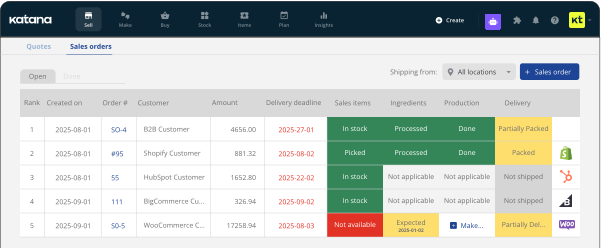
Instead of updating a central file after stock changes, inventory levels adjust automatically as orders are confirmed, fulfilled, or received. The number the team sees reflects current availability rather than the last manual edit.
For multi-location businesses, stock can be tracked by site without someone having to reconcile transfers later. When inventory moves between warehouses or is shipped by a 3PL, availability updates in the system at the same time the physical movement happens. That removes the need to pause and verify which location actually has stock before promising a ship date.
Multi-channel sales benefit in a similar way. Orders placed through ecommerce platforms draw from the same live stock pool, and once inventory is allocated, it is no longer shown as available elsewhere. That alignment reduces cancellations and avoids the follow-up work that comes with correcting orders after the fact.
Purchasing decisions also become more grounded because committed stock and on-hand quantities are visible in one place. Reordering no longer depends on manually reviewing spreadsheets or reconciling separate tools; the team can see what is available and what is already promised before placing the next purchase order.
This level of reliability protects margin and reduces the steady administrative effort that builds up in spreadsheet-based setups. For multi-channel, multi-location teams, real-time inventory becomes the foundation required to scale without adding the same level of manual work.
Switching from spreadsheets to real-time inventory
Most growing product businesses do not need a full ERP to move beyond spreadsheet inventory management. What they need is inventory control that stays accurate without constant manual effort.
For many SMBs, the main hesitation is whether changing systems will disrupt day-to-day operations. But in reality, moving to a system like Katana is usually more contained than expected.
The starting point is the data you already maintain, such as SKUs or stock levels. That information is imported and reviewed before it becomes the live record. Existing tools such as Shopify or QuickBooks are then connected so orders and financial records remain aligned with inventory.
Operational workflows do not need to be rebuilt. The surrounding tools stay in place, and the spreadsheet is replaced as the control layer for stock. For most small and mid-sized product businesses, guided onboarding takes around six weeks, depending on catalog size and data condition.
You can easily test real-time inventory using your own data and see how Katana fits into your existing setup. Start with Katana’s free plan or book a demo to walk through your specific setup with the team.
FAQ: Moving away from spreadsheets
Spreadsheet inventory management becomes harder to sustain when stock moves across multiple locations or sales channels. As order volume increases, maintaining accuracy requires more manual updates and cross-checking. If the team regularly verifies numbers before acting on them, the spreadsheet is no longer functioning as a reliable control system.
The cost of stockouts includes both lost margin and lost customers. Retail studies show that a large share of shoppers purchase from a different retailer when a product is unavailable. For growing product businesses, even a few days of unavailability across several SKUs can reduce weekly margin in a measurable way.
Excel can record stock by location, but it does not update automatically when inventory moves between sites or channels. Transfers, shipments, and allocations require manual edits. As more people interact with the file, the risk of version conflicts and outdated numbers increases.
Spreadsheet inventory tracking depends on manual updates. Real-time systems update stock levels automatically as orders are confirmed, fulfilled, or received. The biggest difference is how current the information is when decisions are made.
For small and mid-sized product businesses, the transition typically takes a few weeks. The timeline depends on catalog size, data quality, and the number of integrations. In many cases, teams can import existing data and connect their current tools without rebuilding their processes.
Not necessarily. Many growing product businesses only need reliable inventory control that connects with ecommerce and accounting tools. A full ERP may introduce more scope – and trouble – than required at this stage.
Get inventory trends, news, and tips every month
Explore all categories
Get visibility over your sales and stock
Wave goodbye to uncertainty with Katana Cloud Inventory — AI-powered for total inventory control