Multi-channel inventory visibility: what most brands get wrong
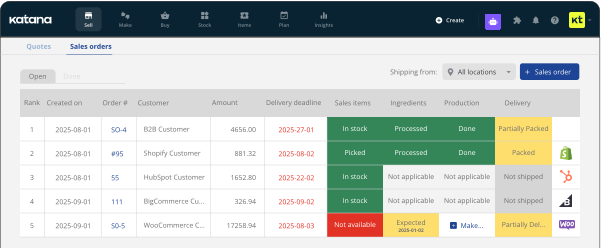
Multi-channel DTC brands lose thousands monthly because they can’t answer “how many can I sell right now?” in under 60 seconds. This post explains why spreadsheet inventory tracking breaks at scale, what real-time inventory visibility actually means (available-to-promise across all locations), and why AI shopping agents make this infrastructure urgent in 2026.


Last month I talked to the founder of an $8M DTC supplement brand. They were losing roughly $50,000 per month to inventory problems. Not theft. Not damage. Not spoilage. Just not knowing where their inventory actually was.
They had inventory in their warehouse. Inventory at their 3PL. Inventory in Amazon FBA. Inventory in transit from their manufacturer in South Korea. Inventory reserved for wholesale orders. Inventory earmarked for upcoming promotions.
When I asked them how they knew their real available-to-promise inventory at any given moment, they showed me a spreadsheet that someone updated manually every morning.
Every morning. Manually. For an $8M business.
This isn’t an edge case. This is normal. And it’s about to become completely unacceptable.
The three lies we tell ourselves about inventory visibility
Before we talk about solutions, let’s acknowledge the lies. I hear these constantly, and they’re preventing people from fixing problems that cost them real money.
Lie #1: “Shopify shows my inventory accurately”
No it doesn’t. It shows what you last synced to Shopify. Maybe that sync happened 15 minutes ago. Maybe an hour. Maybe this morning before you shipped 47 orders from your 3PL.
Shopify has no idea about:
- Inventory in transit between your warehouse and 3PL
- Stock reserved for wholesale orders that haven’t shipped yet
- Inventory at trade shows or in sample kits
- Stock held at a co-manufacturer waiting for label approval
- Units in quality hold that can’t be sold yet
- Inventory Amazon has but hasn’t confirmed in FBA
Your Shopify inventory count is a guess. It might be a good guess, but it’s still a guess.
When AI agents start shopping at scale, they won’t accept guesses. They’ll query your available inventory, get a number, and expect that number to be accurate within seconds. Not “accurate as of this morning.” Accurate right now.
Lie #2: “We reconcile weekly, that’s enough”
Weekly reconciliation doesn’t prevent problems. It just tells you about them a week late.
What happens in that week:
Monday: Your 3PL reports they’re out of stock on SKU #127. But they have 43 units—they just moved them to a different bin and forgot to update the system.
Tuesday: You turn off that SKU on Shopify to avoid overselling. You just lost two days of sales.
Wednesday: A wholesale customer emails asking about a large order. You check inventory and say you can’t fulfill it. They place the order with a competitor.
Thursday: You discover the 3PL has the stock. But the wholesale customer already committed to your competitor.
Friday: You do a manual count and update everything. Finally accurate!
Saturday: Weekend orders deplete inventory faster than expected. Your Monday morning sync will be wrong again.
This cycle costs you sales, creates customer service headaches, and forces decisions based on stale data. Weekly reconciliation just documents the chaos – it doesn’t prevent it.
Lie #3: “We’ll fix this when we’re bigger”
This is my favorite lie because it’s so perfectly backward.
Inventory visibility problems get exponentially worse as you scale, not linearly worse. When you’re doing 100 orders a month from one location, manual tracking works fine. When you’re doing 2,000 orders a month across three channels and two fulfillment locations, manual tracking is constantly wrong.
By the time you’re “big enough” to fix it, you’re so deep in manual processes that the migration is terrifying. You’ve built workarounds on top of workarounds. You have three people whose entire job is maintaining spreadsheets. Changing systems means risking the whole operation.
The right time to fix inventory visibility is before it becomes load-bearing chaos. While you still have the flexibility to move systems without breaking everything.
Most brands wait until inventory problems are costing them six figures annually. Then they spend another year evaluating solutions because they’re afraid of making it worse.
What inventory truth actually means
Let’s define terms, because “inventory visibility” means different things to different people.
When I say inventory truth, I mean: you can answer the question “How many units of SKU X can I promise to a customer right now?” and get an accurate answer within 60 seconds.
Not “how many did we have this morning.” Not “approximately how many based on last week’s count.” How many right now, accounting for:
- Orders placed in the last hour that haven’t shipped yet
- Inventory in multiple locations with different availability
- Stock reserved for specific purposes (wholesale, promotions, etc)
- Inventory in transit that’s not yet available
- Quality holds or damaged stock that can’t be sold
- Different channels (DTC, Amazon, wholesale) pulling from the same pool
This sounds impossible if you’re using spreadsheets. It sounds expensive if you’re thinking about enterprise software. It’s neither; it’s just a system.
The technology exists. Real-time inventory aggregation across locations isn’t hard anymore. APIs from 3PLs provide near-instant updates. Webhook architectures spread changes in seconds.
What’s missing isn’t technology. It’s the mental model.
Most brands think of inventory as data they manage in a system. They need to think of inventory as a foundation they build on. The difference is subtle but critical.
When inventory is a foundation, you don’t ask “Where do I store this data?” You ask, “What processes need this data, and how do I make it available to them?”
This matters more than you think in the agentic commerce era
AI agents are about to stress-test everyone’s inventory systems.
When a human shops, they’re tolerant. You show them a product is in stock, they add it to cart, they check out 20 minutes later. If you oversold in those 20 minutes, you apologize and offer a discount. The human is annoyed but understands.
AI agents won’t be tolerant. They’ll query availability, get a response, make a purchasing decision based on that response, and expect the transaction to complete. If your inventory number was wrong, the agent doesn’t get annoyed—it downgrades your reliability score and shops elsewhere next time.
Google’s AI shopping features are live. Perplexity has shopping integration. ChatGPT is testing product recommendations. Every major AI platform is building commerce capabilities.
They all need the same thing: accurate, real-time inventory data with defined SLAs.
You can’t tell an agent “inventory is usually accurate within a few hours.” Agents need guarantees. “This API returns current available-to-promise inventory with maximum 60-second latency.”
If you can’t provide that guarantee, agents won’t trust your inventory data. If agents don’t trust your data, you’re not discoverable in AI shopping experiences.
This is the forcing function. Not “inventory visibility would be nice to have.” It’s “inventory visibility is required for the next generation of commerce.”

The real costs of inventory opacity
Poor inventory visibility costs more than just overselling (though that’s expensive).
Cost #1: Lost sales from conservative inventory buffers
When you don’t trust your inventory data, you build in safety margins. You keep more stock than you need “just in case.” You mark items out of stock earlier than necessary.
The $8M brand I mentioned? They kept 30% safety stock because they didn’t trust their counts. That’s $240K in inventory they had to finance that could have been working capital. The cost wasn’t the inventory itself, but the opportunities they couldn’t pursue because cash was tied up in safety stock.
Cost #2: Margin erosion from stockouts
When you stock out on Amazon, you don’t just lose sales during the stockout. You lose ranking. You lose the Buy Box. You lose momentum.
Getting back to your previous sales velocity after a stockout can take weeks. The margin impact isn’t the lost sales during the stockout—it’s the reduced pricing power and increased ad spend required to rebuild momentum.
One brand told me a week-long stockout on their top SKU cost them an estimated $30K in lost sales, but the real cost was three months of depressed margins as they fought to regain their category position.
Cost #3: Time spent firefighting instead of growing
This is the insidious cost nobody calculates.
How many hours per week does someone on your team spend:
- Manually updating inventory counts
- Reconciling discrepancies between systems
- Researching “where did these 47 units go?”
- Fielding customer service inquiries about delayed orders
- Coordinating emergency inventory transfers
- Double-checking stock levels before confirming large orders
For most brands doing $2-10M in revenue, someone is spending 10-20 hours per week on inventory reconciliation and firefighting. That’s half an FTE that could be doing anything else.
You’re not paying for inventory visibility. You’re already paying for inventory opacity; you just haven’t calculated the cost.
What good looks like (and it’s simpler than you think)
Good inventory visibility looks like this:
A customer adds a product to cart on Shopify. That unit is soft-reserved for 15 minutes. If they complete checkout, it’s hard-reserved and unavailable to other channels. If they abandon, it’s released back to available stock.
An Amazon order comes in. Your system immediately decrements available inventory, notifies your 3PL via webhook, and updates availability across all channels within 30 seconds.
Your wholesale manager gets a request for 500 units. They can see real-time available inventory, inventory in transit (arriving next Tuesday), and current sell-through rate. They can confidently commit to the order because the data is current.
Your marketing team wants to run a flash sale. They can see exactly how much inventory is available across all locations, calculate how much to allocate to the promotion, and set limits that won’t oversell.
An AI agent queries your available inventory via API. It gets accurate data with a timestamp showing the information is current as of 45 seconds ago. The agent trusts this data enough to complete a purchase.
None of this requires enterprise software or complex implementation. It requires a system that treats inventory as a real-time data source, not a static database you sync occasionally.
The setup your SMB actually needs
Brands need:
Real-time aggregation across locations
Not batch syncs. Not overnight reconciliation. Real-time visibility into inventory across warehouses, 3PLs, Amazon FBA, wherever you hold stock.
This doesn’t mean instantaneous—60-second latency is fine for most use cases. It does mean event-driven updates, not scheduled syncs.
Available-to-promise calculations
Not just “on hand” inventory. Available-to-promise accounts for reservations, in-transit stock, quality holds, and other constraints.
If you have 100 units on hand but 30 are reserved for wholesale and 20 are in quality hold, your available-to-promise is 50 units.
Multi-channel coordination
When inventory depletes on one channel, all channels should update automatically. Not eventually. Automatically.
The days of managing Shopify inventory separately from Amazon inventory are ending. AI agents will query across channels. If your numbers don’t match, you look unreliable.
Audit trails and state history
When something goes wrong – and something always goes wrong – you need to know what happened. Complete history of every inventory movement, every adjustment, every state change.
This isn’t just for debugging. It’s for trust. When your CFO asks “Why did we stock out on our top SKU?” you need to show exactly what happened, when, and why.
Why most inventory systems aren’t built for this
The problem with most inventory management software: it was built for manufacturing, not multi-channel commerce.
Traditional inventory systems assume:
- You control all your inventory locations
- Updates happen on scheduled intervals
- Reconciliation is a batch process you run periodically
- Inventory moves predictably through defined processes
Multi-channel commerce breaks all these assumptions.
You don’t control Amazon’s warehouse. You don’t control your 3PL’s systems. Updates need to spread immediately, not on a schedule. Reconciliation needs to be continuous, not periodic. Inventory moves unpredictably as orders come from multiple channels simultaneously.
This is why brands with complex channel strategies end up on spreadsheets. The software built for manufacturers doesn’t match their workflow. The software built for retailers assumes you control your fulfillment. Nothing was built for co-manufactured DTC brands selling on Shopify, Amazon, and wholesale simultaneously.
What I think happens in 2026
I might be wrong on timing, but I’m confident about the direction.
Prediction 1: The first major agentic commerce failure will be inventory-related
An AI agent will make purchasing decisions based on inventory data that turns out to be wrong. A brand will oversell badly. Customers will complain. The story will circulate.
Suddenly “do you have real-time inventory visibility?” becomes a question brands need to answer confidently.
Prediction 2: “Inventory truth layer” becomes a recognized category
Right now, people talk about inventory management systems. That category is too broad. It includes everything from simple stock tracking to complex manufacturing workflows.
I think we’ll see “inventory truth layer” emerge as a specific category: a system that provides real-time visibility and available-to-promise calculations across channels, without assuming you control fulfillment.
This will be distinct from inventory management (which handles workflows) and warehouse management (which handles fulfillment). It’s the layer that tells you the truth about what you can sell right now.
Prediction 3: Brands will start consolidating systems
Right now, most multi-channel brands use 5-7 different tools for commerce operations. Shopify, Amazon Seller Central, a 3PL platform, maybe an inventory spreadsheet, a forecasting tool, accounting software.
As real-time requirements increase, maintaining this fragmentation becomes impossible. You can’t get real-time truth from seven different systems that don’t talk to each other.
I think we’ll see consolidation around platforms that provide a foundation, not features. Systems that aggregate data from everywhere and make it queryable in real-time, rather than trying to do everything themselves.
What to do about this (starting tomorrow)
If you’re running a multi-channel brand and this resonates:
Step 1: Calculate what inventory opacity costs you
Track for two weeks:
- Hours spent on manual inventory reconciliation
- Lost sales from conservative stock buffers
- Customer service time spent on inventory-related issues
- Emergency inventory transfers that wouldn’t have been needed with better visibility
Put a dollar value on it. You’re probably spending more on inventory opacity than you’d spend on a system to fix it.
Step 2: Audit your current inventory accuracy
Pick 10 random SKUs. Check what your systems say you have across all locations. Then check what you have.
If the numbers match within 5%, you’re doing better than most – industry benchmarks put world-class inventory accuracy at 95%, with the average sitting around 91%. If they’re off by more than 10%, you have a real problem that’s costing you money every day.
Step 3: Map your inventory complexity
List every place you hold inventory:
- Your warehouse
- 3PL(s)
- Amazon FBA
- In transit from manufacturer
- At trade shows or events
- Sample inventory
- Quality hold
If you have more than three locations, you need a better system. Spreadsheets won’t scale. Manual tracking will break.
Step 4: Test the 60-second question
Right now, without preparation: How many units of your top-selling SKU can you promise to a customer?
If it takes you more than 60 seconds to answer confidently, your inventory setup isn’t ready for agentic commerce.
Why this is urgent (even though it doesn’t feel urgent)
Inventory visibility problems accumulate slowly, then hit you all at once.
In our work with multi-channel merchants, manual tracking rarely keeps up once orders are flowing across more than two channels. The hours spent reconciling data quickly outweigh any cost savings from avoiding a proper system.
When you’re doing 500 orders a month, manual tracking works. At 1,000 orders, it’s annoying but manageable. At 2,000 orders, it’s painful but you’ve built workarounds. At 5,000 orders, it’s crisis mode and you desperately need to fix it but you’re too busy firefighting to implement a solution.
The time to fix this is before the crisis, when you still have the operational bandwidth to implement properly.
The agentic commerce shift makes this urgent in a new way. You’re not just optimizing for efficiency anymore. You’re building a foundation that determines whether you’re discoverable to the next generation of shoppers.
If AI agents can’t trust your inventory data, they won’t include you in shopping results. You’ll be invisible to a growing segment of commerce.
Google’s AI shopping features are live now. Perplexity has commerce integration now. ChatGPT is testing shopping now.
The brands building real-time inventory systems today will have a compounding advantage. The ones waiting for it to become urgent will spend 2026 and 2027 playing catch-up.
The choice is: build a better system while you have breathing room, or scramble to fix it during a crisis.
I know which one I’d choose.
Get inventory trends, news, and tips every month
Explore all categories
Get visibility over your sales and stock
Wave goodbye to uncertainty with Katana Cloud Inventory — AI-powered for total inventory control