Google + Shopify’s agentic commerce push: how SMBs stay discoverable
Google and Shopify are rolling out the Universal Commerce Protocol and new AI shopping flows that can take a shopper from search to checkout without relying on your website. This post breaks down what’s changing and gives SMBs a practical checklist to stay discoverable by shopping agents.


Google and Shopify are pushing agent-led shopping closer to checkout. They introduced the Universal Commerce Protocol, an open standard meant to help AI agents connect to merchants and complete commerce tasks. They’re putting that protocol work into shopping flows where an assistant plays a bigger role in the buying moment, carrying a shopper all the way from research to purchase.
As checkout moves into assistant-driven flows, day-to-day operations start shaping who gets chosen. Clear, accurate operational data is no longer an afterthought: the businesses that keep their inventory and delivery promises consistent can earn more of these agent-led purchases as the channel grows, which opens a precious door for SMBs.
“When Google, Shopify, major retailers, and payment networks all align on a protocol, you should take notice.”
— Riikka Söderlund, COO at Katana
What is the Universal Commerce Protocol?
The Universal Commerce Protocol (UCP) is a new open-source standard from Google, co-developed with partners including Shopify, that defines a common way for AI agents to interact with merchant systems during a purchase.
In practice, UCP is designed to reduce the one-off work of building a custom integration for every shopping assistant. With this “common language” in place, a merchant (or the tools they already use) can expose a consistent set of commerce actions, so an agent can confirm availability and handle checkout with less custom work.
Google’s developer write-up describes UCP as a “common language” with functional building blocks that connect shopper interfaces with businesses and payment providers, while still letting the retailer remain the seller of record.
This pushes operational data into the buying moment, often outside your storefront. Availability and delivery promises become part of how you get picked, so your systems need to return accurate, timely answers. If they don’t, an agent has an easy reason to move on to another option.
Checkout inside Search and Chat: what changes for merchants
Google is moving checkout into AI Mode in Search and the Gemini app on eligible product listings, powered by the Universal Commerce Protocol. Shopify is treating these AI shopping surfaces as another channel a merchant can run through Shopify Admin, alongside the sales channels many SMBs already manage there.
Shopify’s framing points to something bigger: AI shopping surfaces add yet another place where discovery and checkout can happen, and this one could scale fast. That brings checkout outside the merchant’s website as well, and inside the assistant experience.
The plan is to support checkout with Google Pay using saved details in Google Wallet. PayPal support has also been referenced. The retailer remains the seller of record, which keeps fulfillment and customer service with the merchant.
The decision stage is changing too. Business Agent lets people chat with a retailer directly in Search, managed through Merchant Center. New Merchant Center attributes are designed for conversational shopping, and Direct Offers in Google Ads are being tested to surface discounts in AI Mode.
Together, these updates make availability and ship dates harder to hide behind a storefront. That sets up the next question: what needs to change in day-to-day operations so an agent can confidently pick you.
How SMBs can stay discoverable to AI agents
An agent can only recommend what it can confirm. Discoverability starts with availability and delivery promises that hold up the moment a shopper decides to buy inside an assistant experience.
Day to day, that comes down to two jobs:
1) Keep stock counts trustworthy across every location that can fulfill an order.
2) Keep lead times current in the systems that feed your selling channels.
Inconsistent numbers break the buying flow at the worst time: right at checkout.
Focus on these actions to stay discoverable in agent-led shopping:
- Keep stock accurate across locations. Track on-hand and reserved stock. Pay extra attention to any location that fulfills orders, including 3PL sites.
- Keep Shopify and inventory in sync. Keep product and stock updates flowing between Shopify and your inventory management system.
- Keep lead times current. Update supplier and production timelines when they change. Keep the same lead time logic across tools.
- Clean up product data that affects ordering. Make variants and pack sizes match what you actually ship.
- Cut manual handoffs. Reduce copy-paste work between Shopify, fulfillment tools, and accounting. Connecting tools through integrations helps keep orders and inventory movements aligned.
- Decide how you handle exceptions. Set rules for backorders and substitutions. Keep those rules consistent by channel.
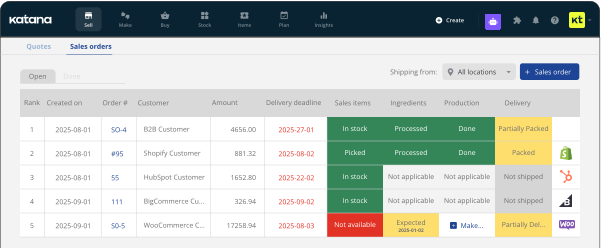
Using Katana: Katana sits alongside Shopify, 3PL tools, and accounting to give teams one place to track stock across locations and keep orders connected to inventory movements. With the native Shopify integration, it’s easier to keep storefront availability aligned with what the team can fulfill, while also managing lead times tied to purchasing and production.
Agentic buying vs SMBs: trouble or opportunity?
The storefront has carried a lot of weight. It’s where brands build trust and answer the questions that help someone feel confident enough to buy.
Agent-led checkout moves some of that trust-building into the assistant experience. Shoppers can ask for options, compare, and even place an order without spending much time – if any – on a brand’s site. The systems behind the scenes do more of the convincing.
“For twenty years, owning the web store meant owning the customer relationship. The front end was the gate. The brand lived there. Now even Shopify is saying the store is optional. That should make any brand pause.”
— Riikka Söderlund, COO at Katana
As more shoppers ask an assistant what to buy, SMBs compete on clarity as much as brand. That’s where operational discipline becomes a growth advantage. If assistants become a common place to shop, SMBs have a shot at earlier discovery without paying for the same kind of storefront traffic. Accurate availability can beat a bigger brand that overpromises, and consistent inventory keeps you in the running.
Get inventory trends, news, and tips every month
Explore all categories
Get visibility over your sales and stock
Wave goodbye to uncertainty with Katana Cloud Inventory — AI-powered for total inventory control