Scaling without an ERP (and without a 6-month implementation)
Is an ERP the right solution for your product SMB?
Eventually, all companies face this question. When manual processes and disconnected tools can no longer keep up with growth, an ERP might seem the logical next step. Oftentimes, though, that’s not the case. This is why and how you can scale using stackable systems your team can implement in weeks.


When you’re small, it’s easy to keep things moving with whatever tools you already have. As you grow, the gaps between those tools start costing you time double-checking numbers and fixing mismatches at handoffs.
That’s usually when “we might need an ERP” comes up. It sounds like the safer choice because it promises one system and one set of numbers. For a lot of product SMBs, it can also be risky: a very time-consuming project that needs to be handled by team members who already have a day job, while the business keeps shipping orders.
This post lays out an ERP alternative for growing product businesses: a stackable setup that keeps inventory, fulfillment, and accounting aligned without a 6-month full-time implementation. We’ll look at where ERP projects tend to go wrong, alternatives to connect your tools, how to pick the right core inventory management system, and what a phased setup can look like in practice.
Why are ERPs risky for growing product businesses?
Implementing an ERP involves redesigning the way your whole business runs in one project. While it can make sense for some companies, it’s a risky first move for product SMBs because it represents a large internal project at the exact time the team is already stretched.
Implementation experts point out a few common problems:
- Unclear priorities. Teams bring a long list of requirements that mixes must-haves with nice-to-haves. Without a clear order, the project balloons and people end up arguing about edge cases instead of getting a working baseline in place.
- Messy data. Product records usually live in more than one place. SKUs, units of measure, supplier names, locations, and BOMs often don’t match across systems. Someone has to clean that up before the ERP can produce numbers the team trusts.
- Workflows that aren’t written down. A lot of the “real process” sits in people’s heads. When you move to an ERP, those steps need to be made explicit: what happens when stock is received, when orders are allocated, when something is partially fulfilled, what triggers a purchase order. If those decisions happen late, the setup turns into rework.
- Trying to change everything at once. ERPs tend to pull sales, ops, and finance into one rollout. That increases training load and makes it harder to spot what’s broken when something doesn’t work as expected.
- Hard to reverse. Once multiple teams rely on one suite, swapping it out is expensive. That pressure can lead to “we’ll live with it” decisions that stick around for years.
Legacy tools and manual steps don’t scale
If an ERP feels like too much, the usual fallback is keeping existing tools and filling gaps with manual work. This holds up until the business grows and more parts need to stay in sync.
Stock sits in different systems – ecommerce, fulfillment, accounting – and each records a different moment in the process, so there’s no single set of numbers the team can rely on. Someone has to export data, adjust it, import it again, and check if it looks right. That manual work becomes the link between systems, which takes time and creates a dependency on whoever knows the setup.
Mismatches surface late – right before an order ships or when someone tries to reorder – and interrupt work already in motion. Adding a channel, warehouse, or 3PL means more checks and steps. The system stays messy and gets harder to manage.
Stackable systems let you keep tools that work and connect them, so daily work doesn’t depend on manual fixes.
The ERP alternative for growing product businesses: stackable systems
Stackable systems let you scale without replacing everything. You keep tools that do their job and connect them around one system that holds inventory and order status: your inventory system of record.
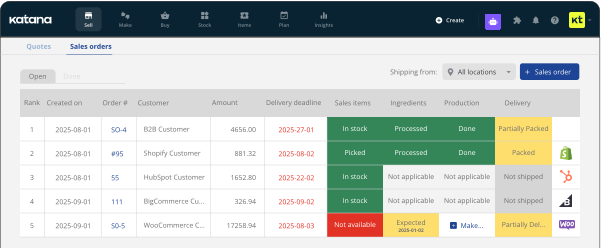
Pick that inventory system first. For many product businesses, this is where Katana fits: it tracks stock across locations, manages purchasing, and keeps open orders visible. Sales channels like Shopify feed orders into it. Fulfillment partners connect to it through supported integrations or API-based connectors. Accounting syncs inventory movements and purchasing with it. The rest of your stack stays in place, but the handoffs are defined and the numbers don’t depend on manual reconciliation.
Once the core is stable, add connections in order:
- Connect accounting early. If inventory movements and purchasing don’t flow into the books, finance has to manually reconcile the differences.
- Use native integrations when available. They’re faster to set up and easier to maintain than custom work.
- Add tools that remove specific problems. A new warehouse management system makes sense when picking, packing, and warehouse workflows get complex. Batch and lot traceability matters for compliance-driven teams. If a tool just creates another place to check numbers, it’s not solving the problem.
This approach reduces risk because you don’t have to redesign the whole business at once. It also gives you room to swap tools over time without restarting from scratch, as long as the operational core stays stable.
What your inventory system needs to handle before you scale
Your inventory system should hold inventory and order status in one place. It needs to track stock reliably and reflect real demand so the rest of your tools work from the same numbers.
Here’s what to check before you commit:
- Multi-location stock that matches how you work. For businesses with stock in multiple places, the system needs location-level inventory that includes transfers, adjustments, and routing rules for fulfillment.
- Clear “available” vs “committed.” The system should separate stock on hand from stock allocated to open orders. Without that split, teams either oversell or hold stock back unnecessarily.
- Purchasing that reflects real demand. Purchase orders should be driven by open sales orders, current stock, and lead times.
- Bills of materials for assembly or bundling. Teams that kit, bundle, or do light production need BOMs the team can maintain. BOM errors create incorrect stock counts and bad costing.
- Traceability for compliance. Businesses that need batch and lot traceability should check how lots are recorded at receiving, how they flow through fulfillment or production, and how quickly you can trace a batch.
- Integration behavior, not logos. “Integrates with Shopify” means nothing on its own. Check what data syncs, how often, and what happens with returns, partial shipments, cancellations, stock adjustments, and backorders.
A solid inventory management system makes the rest of the stack easier to connect because you’re building around stable numbers.
A rollout plan for a connected stack
Rolling out a connected stack is usually much quicker than an ERP. It can still drag when teams try to change too much at once or start connecting tools before the inventory system is stable. A faster rollout starts with the inventory system of record, gets the basics working, then adds the next integration after the team is using it day to day.
- Define what “working” means for day one.
Write down the minimum you need to run operations without workarounds. Keep it tight. Everything else goes on a later list. - Get your core data in a usable shape.
Focus on the basics your system needs to run: a clean SKU list, consistent units, and accurate locations. Add BOMs only if you assemble, bundle, or kit products. - Set up the operational core, then connect accounting early.
Get inventory and order status stable first. Then sync with accounting so finance isn’t rebuilding the picture at month-end. - Add one connection at a time.
Bring in the next system only when it removes a specific problem. Postpone anything that adds another place to check numbers. - Run a proof period before full cutover.
Test the workflow end to end using a single location or one order type. Fix mapping and rules there before expanding. - Assign clear ownership.
Decide who owns ongoing data hygiene and who owns integrations. A rollout moves faster when decisions don’t stall.
This approach keeps the project moving without turning it into a full redesign. You get a working system in place early, then build from there without reopening the foundation every time you add something new.
Is an ERP the right solution for your SMB?
An ERP can be worth it when:
- you’re managing many entities and need heavy consolidation
- you have complex controls and the staffing to run a long program
- your requirements genuinely call for one suite across departments
Otherwise, a stackable approach is often the safer first step.
How to scale without an ERP project
Most businesses look at ERPs because their current tools don’t sync and someone has to fix the gaps manually. A stackable setup removes that problem without redesigning the business.
Pick one inventory system to hold inventory and order status. Get it stable, connect accounting early, and add integrations as they solve real problems.
Practical next step: test this with Katana’s Free plan using a small set of SKUs and one workflow. The Free plan gives you unlimited SKUs for 15 days and 3 locations, so you can see whether Katana works as your inventory system of record before committing.
A stackable setup built around an inventory system of record. One operational core holds inventory and order status, then the rest of your tools connect to it. Many product teams use Katana in that operational core role.
Yes, if you decide which system owns each piece of data and keep handoffs consistent. Silos usually come from tools being added without clear rules for what syncs where.
Start with the operational core, then connect accounting early so stock movements and purchasing don’t need manual fixes at month-end. After that, connect sales channels and fulfillment partners in a clear order.
When the spreadsheet becomes the place your team checks before accepting an order or reordering stock. At that point, the spreadsheet is acting like your inventory system, and it’s easy for it to fall out of date.
It depends on how clean your product and location data is, and how much you try to change at once. Many teams can get a working baseline in weeks, then add the next integration after that.
When you need heavy consolidation across entities, strict controls, or one suite across departments. Otherwise, a connected stack is often the safer starting point.
Get inventory trends, news, and tips every month
Explore all categories
Get visibility over your sales and stock
Wave goodbye to uncertainty with Katana Cloud Inventory — AI-powered for total inventory control