Why AI forecasting isn’t just for Walmart: What SMBs can learn
AI forecasting usually gets talked about in the same breath as Walmart and other big-box giants. But what if your team could do it as well?
In this post, we look at what Walmart is doing with data and inventory, and break down what product SMBs can borrow from that playbook.


Every time inventory and AI are mentioned in the same sentence, Walmart is not far behind.
With the holidays right around the corner, stores are filling up with toys, turkeys, and everything that goes with them – and nobody is wondering how many units should land in which store.
Walmart runs huge machine learning models on sales data, online behavior, promotions, weather, and local patterns to decide what to send where and when. Those models guide inventory across thousands of stores and distribution centers, down to individual products and locations.
On top of that, Walmart has started tagging grocery pallets with tiny ambient IoT sensors that report where those pallets are and how long they have been sitting. That stream of data feeds back into the same AI systems, so the company has a live view of how inventory is moving through its network.
Now bring this down to the size of a product business selling on Shopify and Amazon, maybe TikTok Shop, with stock split between a small warehouse and a 3PL. The tools look different, but the stakes around forecasting feel familiar.
If you misjudge demand, you either spend money on stock that sits for months or you miss sales when a product takes off. Globally, that combination of overstock and stockouts adds up to well over a trillion dollars in lost value every year.
This is where AI forecasting starts to matter outside big-box retail. The same ideas that help Walmart position inventory across thousands of locations can help a 10–50 person team decide what to reorder, where to hold it, and when to commit. The difference is scale and tooling.
What Walmart is doing with AI forecasting
Walmart has written publicly about how its teams train forecasting models. They mix historical sales with search and browsing data from their site. On top of that, they add “future” inputs like macro weather and economic trends, along with local demographic data.
The models look at how demand behaves across different product groups and regions over time. That helps estimate demand at store level and highlight where planned flows through the supply chain are likely to be off.
These models sit inside an AI-powered inventory system. The system sees a gap between expected and real demand, flags issues early, and suggests changes in ordering or allocation before problems show up on the shelf.
The IoT deployment on grocery pallets adds another layer. Millions of battery-free sensors will eventually report location, temperature, humidity, and dwell time across roughly 90 million pallets in the US. That data flows into Walmart’s AI stack, which uses it to tighten replenishment decisions and reduce waste without adding more manual checks.
All of this runs continuously. Models see new sales and inventory data on an ongoing basis. They adjust as weather changes, promotions land, or local events change shopper behavior. Forecasting at Walmart is better thought of as a continuous process between data, models, and the teams who use them:
- Data from stores, ecommerce, and supply chain moves into a shared environment
- Models turn that into forecasts and exception signals
- Planners and merchants review those signals and adjust how stock moves
You don’t need Walmart’s budget to copy that pattern. You need a smaller, more focused version that fits a product SMB.
How the same pattern shows up in smaller product businesses
You see a similar pattern inside product SMBs, just with fewer zeros.
Most brands do not sell in one place only. A typical setup includes an online store, at least one marketplace, and sometimes a small wholesale book. Stock is often split between a main warehouse, a back room, and a 3PL. Demand can concentrate in one channel after an email campaign or a creator mention, while replenishment is still planned on a combined number. One side ends up short while another sits on stock.
Manufacturing-led SMBs have their own version. They manage BOMs, shared components, and a mix of made-to-stock and made-to-order work. A few B2B customers drive a big part of demand. Some of those customers order on a steady pattern, but that rhythm is rarely modelled clearly. Shared materials are pulled into those peaks, and purchase orders follow late even though the behavior repeats.
Hybrid operations echo what happens in Walmart’s network, just on a smaller grid. It is common to see a mix of in-house production, co-manufacturing, and several 3PLs. Each external partner reports stock and lead times in a different format. Someone on the team has to pull those numbers out of portals and files, paste everything into a workbook, and then try to make sure the numbers on each tab belong together.
In most of these businesses, that workbook doubles as the forecasting tool. A planner who understands the range builds formulas, adds their own sense of seasonality, and adjusts figures based on what they expect from channels and key accounts. This works up to a point. As orders grow and more channels come into play, the file slows down, becomes brittle, and is hard for anyone else to maintain or trust.
At that point, the parallels with Walmart become clearer. Data scattered across tools, planning logic locked in one workbook, and many signals that never quite make it into the forecast.
This is the moment where two steps matter more than anything “clever” in AI:
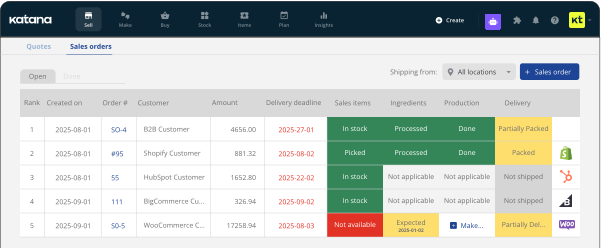
- Pull operational data into one system that tracks stock, orders, and production in real time, such as Katana.
- Let a forecasting tool read that data and learn from how demand, supply, and lead times have behaved so far.
Once that base exists, the overlap with Walmart’s habits is tangible, even on a very different scale.
What AI forecasting looks like in practice for SMBs
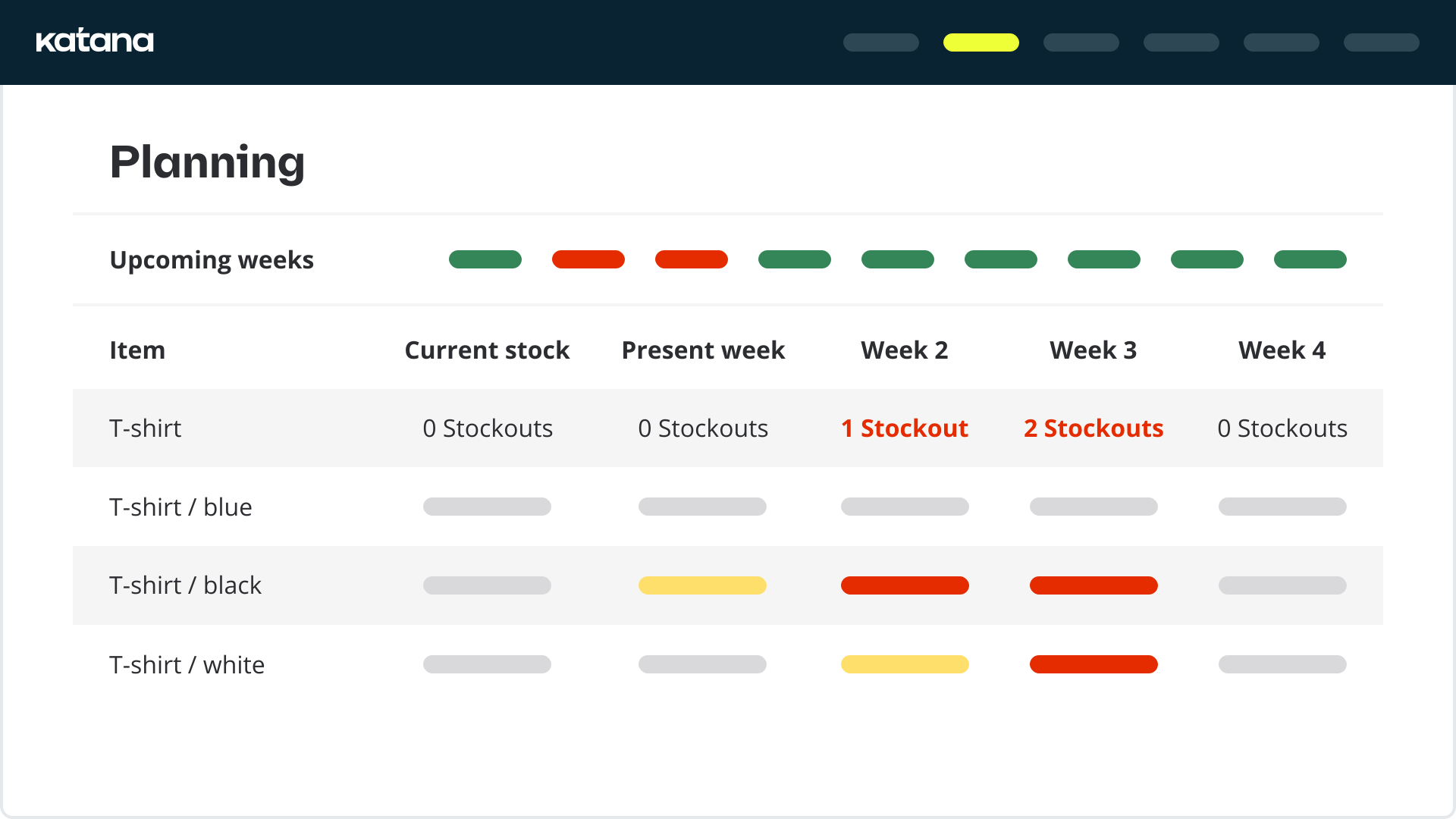
For a product SMB, AI forecasting is usually delivered through an AI decision intelligence platform like ConverSight, a Katana partner. Katana holds the day-to-day data about stock, orders, and production. ConverSight’s AI employee, Athena, connects to Katana data, sales channels, and supplier inputs to generate forecasts, identify risks, model scenarios, and recommend actions across purchasing, inventory, and production.
At a basic level, these tools read your history, learn how demand tends to behave, and then propose a view of likely future demand with suggested actions around it.
ConverSight typically pulls in:
- Sales by SKU, channel, and customer
- Stock levels by location
- Supplier lead times and order quantities
- Markers for seasonality and major campaigns
With that link in place, the model can start to surface patterns such as:
- SKUs that peak at similar times each year
- Channels that create bursts of demand rather than a steady flow
- Suppliers whose real lead times are consistently longer than recorded
- Customers who order in clear cycles
House of Spices, a food manufacturer working with a big range of SKUs, improved forecast accuracy by over 30% and reduced inventory waste by nearly 20% after moving from manual forecasting to an AI-driven approach. Another mid-sized manufacturer that kept running short on the same raw material used AI forecasting to spot a regular order pattern from a key customer, then simply brought its own purchasing forward by a couple of weeks and stopped seeing that recurring shortage.
These examples are common in product businesses that sell through more than one channel and rely on a mix of materials and suppliers. Once a planning tool can read clean operational data and recognize repeating behavior, it becomes easier to see risk and opportunity early enough to act on it.
What small teams can borrow from Walmart
Seen side by side, Walmart’s approach suggests a few practical habits smaller teams can adopt.
1. Connect the data
Walmart puts serious effort into bringing store, online, and supply chain data into one environment before building models.
For a product SMB, that usually means moving away from separate spreadsheets and into a shared operational system. Stock across all locations, sales from each channel, and open purchase and production orders should live together. Katana is one option here, but the important part is that day-to-day work and planning use the same numbers.
2. Use more than one demand signal
Walmart’s models draw on sales, weather, events, and online behavior.
You can apply a simpler version. Useful signals often include:
- How each channel reacts to different kinds of campaigns
- Regular ordering schedules from key accounts
- Known seasonal patterns for your range
Tools like ConverSight are designed to combine these inputs. The main job on your side is to make sure they are captured in the data.
3. Keep forecasting in motion
At Walmart, models are refreshed often and feed into frequent decisions on ordering and allocation, not just annual plans.
For a small team, a weekly review is usually enough. Open the forecast, deal with items that look off, and nudge purchase and production plans before those gaps turn into lost sales or excess stock.
4. Share one view of what is coming
Walmart shares insights with suppliers and store teams through products like Scintilla.
In an SMB, sharing can be lighter but still important. Operations, finance, and whoever runs campaigns should all work from the same forecast view coming out of your AI tool. When everyone sees the same picture, it is easier to align decisions around stock, spend, and capacity.
A simple weekly routine with AI forecasting
Once an AI forecasting tool is running on your data, it helps to give it a clear slot in the week.
1. Start with what looks unusual
Begin by scanning for SKUs where actual demand is far from the forecast. Some will be moving faster than expected, others slower, and some will be building up without sales. Start with items that matter most for revenue or margin.
2. Work through key alerts
- Low stock risk
When the tool flags a low stock risk, check supplier lead times and open purchase orders in your inventory system. If nothing is due within a reasonable window, raise a PO now. If stock is already on the way but lead times have slipped, consider raising safety stock for that item.
- Excess inventory
For products where you hold more than the forecast suggests you need, look at recent demand. If the slowdown seems steady, reduce or pause reordering. You can also plan small promotions, build bundles, or send more units to a channel that still moves them.
- Demand spike
A spike is a signal to look for the story behind it. Check which channel drove the increase and whether a campaign or creator mention explains it. If the activity is likely to repeat, add capacity or purchasing. If it looks like a single event, you may choose to meet the extra demand without making big structural changes.
- Forecast change
A “forecast change” alert usually means the tool has picked up new behavior across several data points. That might come from longer lead times, changed pricing, or a channel growing faster than planned. Review those factors in your main system, update them where needed, and let the model recalculate.
3. Run one “what if”
Before closing the session, ask one simple scenario question. For example:
- “What happens to stock if demand for this SKU doubles on TikTok Shop next month?”
- “What does our position look like if the main wholesale customer cuts orders by 20% next quarter?”
Use the answer as input when you adjust purchase orders and production in Katana. Over time, this habit links the AI’s view of the future with actual changes in how you plan.
Bringing it together for product SMBs
Walmart’s setup can look distant from the day-to-day work of a small product business. There are specialist teams, custom platforms, and millions of sensors in the mix. Underneath, though, the pattern is familiar: keep operational data in one place, look at more than one signal when you plan, and keep adjusting as reality changes.
Product SMBs already have most of the raw material for that. Orders flow through Shopify, Amazon, wholesale, and other channels. Stock and production run through tools like Katana. Supplier behavior and customer habits repeat across months and seasons. AI forecasting, through a planning tool like ConverSight, is a way to read all of that more carefully and turn it into earlier, clearer decisions.
You don’t need to copy Walmart’s stack to benefit from the same thinking. Start by getting stock, orders, and production into one shared system. Connect an AI forecasting tool to your inventory management system. Then give it a regular slot in the week: review the forecast, act on the alerts, and ask a few “what if” questions before you commit cash to new stock. Over time, that steady rhythm does more for your margins and your sanity than any one-off planning sprint, no matter how many stores you run.
Get inventory trends, news, and tips every month
Explore all categories
Get visibility over your sales and stock
Wave goodbye to uncertainty with Katana Cloud Inventory — AI-powered for total inventory control