Amazon fees changed again: Quick margin check and priority actions
Amazon’s next fee update lands Jan 15, and it won’t hit all SKUs the same way. This post covers what changes, then walks you through a quick SKU-level check and an impact vs effort way to pick actions before the date hits.

Amazon’s next fee update kicks in Jan 15. If you sell on Amazon and you care about margin, it’s worth a quick check. Not everything changes, but a few fee lines can move the numbers more than you’d expect once you look at a specific SKU (stock keeping unit).
The impact won’t be the same for every product. It comes down to Amazon’s rate card for that item (size and weight classification) and the way you manage inbound and replenishment.
That’s also why “last quarter’s costs” can’t be the baseline. Katana’s 2025 data shows some companies saw inventory value swing by 60%+ month to month in 2025, and COGS (cost of goods sold) in North America more than doubled over the measured period.
This post walks through a 60-minute routine to refresh the few inputs that matter, then recalc margin under the Jan 15 fees.
Amazon fee changes effective Jan 15: what changed and how it affects unit margin
Here are the changes worth modeling. They hit unit economics, inbound cost, or both.
FBA fulfillment fees: the per-unit change depends on size and price
Amazon’s headline for 2026 is an average +$0.08 per unit starting Jan 15. That’s a blended number across size tiers and price bands, so it won’t match your catalog.
Amazon sets fulfillment fees based on the item’s size tier (packaged size/weight) and its price band. For margin work, use the fee line for the tier and price band your SKU sits in.
- $10-$50: Small standard +$0.25, Large standard +$0.05 (avg)
- Above $50: multiple breakdowns put standard-size items above $50 at +$0.31 on average.
If you sell higher-priced standard-size items, run those SKUs early in the margin check.
Bulky items: new tiers, lower fulfillment fees on average, plus a packaging fee risk
Amazon is splitting the current Large Bulky tier into Small Bulky and Large Bulky. Items that land in these tiers under the new rules pay lower fulfillment fees than those same items would have paid under the previous tier map. Amazon’s summary gives the average change as −$2.06 for Small Bulky and −$0.26 for Large Bulky.
- There’s also a separate packaging-related risk: a packaging service fee averaging $2.07 per unit can apply to Small/Large Bulky items that aren’t eligible for SIPP (Ships in Product Packaging). That means for bulky SKUs, you need two checks: (1) where the item lands under the new size tier rules, and (2) whether your packaging setup triggers the extra fee line.
Inbound placement: fee math depends on the split option
Large Bulky using “minimal shipment splits” increases by $0.27 per unit on average in 2026. There’s no inbound placement service fee with the Amazon-optimized shipment splits option.
Use the split option you use in real life when you recalc margin. If you rely on minimal splits for certain SKUs, include the placement fee line for those items.
Low-inventory-level fee: charged when historical days of supply is under 28 days
Amazon charges this fee when a SKU’s historical days of supply is below 28 days in both the last 30 days and the last 90 days (based on inventory relative to sales). This applies to standard and bulky, including Small/Large Bulky.
If you keep FBA (Fulfillment by Amazon) stock lean on certain SKUs, add this fee line to the margin calc for those items and rerun it after any replenishment or demand change.
If you price under $10: check the Low-Price FBA rates
Products priced under $10 automatically receive Low-Price FBA rates, averaging $0.86 less than standard FBA rates.
That can change how you think about price points for a small set of SKUs.
If you use MCF (Multi-Channel Fulfillment)/Buy with Prime/AWD (Amazon Warehousing and Distribution):
- MCF: +$0.30 per unit on average
- Buy with Prime: +$0.24 per unit on average
AWD West storage: $0.57 per cubic foot per month
Quick margin check for Amazon fee changes
Use this check to measure the Amazon fee changes effective Jan 15 against your current SKU margins.
Step 1: Pick the SKUs to check
Start with:
- Your top Amazon sellers
- Your lowest-margin Amazon sellers
- Anything bulky, oversize, or close to a size tier edge
Keep the list focused and small enough that you can finish the check in one sitting.
Step 2: Refresh the inputs that change
For each SKU on the list, pull four numbers and make sure they’re current:
- Sell price (the price you expect to run after Jan 15)
- Item cost (latest supplier cost, not last quarter’s)
- Packaging assumption (what you’re shipping in, and whether bulky packaging rules apply)
- Inbound assumption (your placement option for that SKU, especially if you use minimal splits)
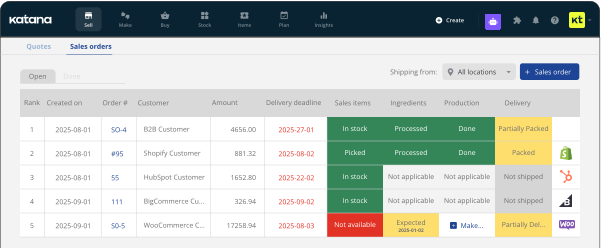
This is easier with an inventory system of record like Katana. When item costs and inventory movement live in one place, rerunning this check is much less work.
Step 3: Calculate the new per-unit margin
For each SKU, line up:
- Current Amazon fee line(s) you pay today
- Jan 15 Amazon fee line(s) for that size tier and price band
- Any placement fee line you expect (based on your split option)
- Low-inventory-level fee line if you often run under 28 days of supply
Then calculate:
- New contribution margin per unit = price − (item cost + Amazon fees + inbound placement + any other per-unit Amazon fees you pay)
This step helps you understand which SKUs are still healthy, which need a change, and which you should deprioritize on Amazon for now.
Step 4: Tag what changed for each SKU that drops
For any SKU where the new contribution margin is meaningfully worse, add one short tag.
- Fulfillment fee change (size tier + price band)
- Bulky packaging fee (SIPP eligibility)
- Inbound placement fee (minimal splits vs Amazon-optimized splits)
- Low-inventory-level fee (often under 28 days of supply)
Write one note per SKU: “Margin down because ____.”
This tells you what kind of fix is even possible. A pricing issue gets a different response than an inbound or packaging issue.
Step 5: Pick one next step per SKU
For every SKU that drops below your target margin, choose one action and move on.
- Price change (new floor price, or stop discounting that SKU on Amazon)
- Packaging change (change pack-out so the fee outcome changes, or make SIPP eligibility realistic)
- Inbound change (split option for that SKU, or change how often you send inventory)
- Replenishment change (a steadier in-stock target for SKUs exposed to the low-inventory fee)
- Channel decision (reduce focus on Amazon for that SKU and push it through other channels)
You’ll use these choices in the next section to sort actions by impact and effort.
Priority actions before Jan 15: Impact vs effort
You already tagged what changed for each SKU. Use that tag to pick the smallest action that fixes the margin.
High impact, low effort
Raise the floor price on exposed SKUs
If the margin drop comes from a straight fee increase, set a new minimum price for that SKU on Amazon and stop discounting below it.
Don’t send “borderline” SKUs to FBA until you rework the math
When inbound placement or low-inventory fees drive the drop, reducing FBA exposure on that SKU can buy time while you adjust packaging or replenishment.
Switch placement option where it’s driving cost
If a SKU’s tag is “inbound placement fee,” make sure your margin calc uses the same split option you plan to use after Jan 15, and change the option for that SKU if needed.
High impact, higher effort
Change packaging on bulky and near-threshold items
For SKUs tagged “bulky packaging fee,” focus on pack-out rules, materials, and what you can realistically qualify for under SIPP. If the packaging service fee applies, it belongs in the margin model before you decide on pricing.
Change how you replenish SKUs exposed to the low-inventory fee
For SKUs that regularly run under 28 days of supply, set a steadier in-stock target and adjust reorder timing. A steadier in-stock target reduces swings that trigger the fee.
Lower impact, low effort
Limit the check to your decision set
After you adjust the top offenders, rerun the margin calc only on the SKUs you changed. Don’t turn this into a catalog-wide project.
Lower impact, higher effort
Rework fulfillment mix for a small group of SKUs
If the same SKUs keep landing in “fees make this hard,” decide whether Amazon is still the right fulfillment path for them. Some items work better through a 3PL (third-party logistics provider) or other channels, especially when packaging and inbound constraints are tight.
What this signals for 2026
Amazon’s Jan 15 update is another reminder that margin math needs a refresh cycle. Fees change, and the cost inputs behind COGS can change fast too. Our 2026 Trends Report points to rising inventory costs and ongoing tariff risk as a continuing source of cost pressure.
Expect more rule changes that reward steadier inbound and steadier stock positions. Treat fee updates as a trigger to refresh item costs and double-check how inventory moves through FBA and your 3PL. For a deeper primer on keeping inventory data reliable, check out our Inventory Management Guide.
Get inventory trends, news, and tips every month
Explore all categories
Get visibility over your sales and stock
Wave goodbye to uncertainty with Katana Cloud Inventory — AI-powered for total inventory control