Omnichannel vs Multichannel Inventory Management: What’s the Difference?
Multichannel inventory management means selling through multiple sales channels — Shopify, Amazon, wholesale — with a shared, real-time inventory record across all of them. Omnichannel goes further: it creates a unified customer experience across every channel, where the same cart, loyalty status, and service history follow the customer regardless of where they shop. Most growing product businesses need multichannel first. Omnichannel comes later.














What is multichannel inventory management?
Multichannel inventory management connects the stock records across multiple sales channels so that a sale on one channel immediately updates availability everywhere else.
The channels remain separate — separate storefronts, separate checkouts, separate marketing — but they share one inventory pool. When a product sells on Amazon, Shopify reflects the updated count before the next buyer can oversell it. When a 3PL ships an order, all channels update at once.
This is the operational foundation for any brand selling across more than one platform. Without it, each channel holds its own view of stock. The gaps between those views are where oversells and manual reconciliation happen.
For a full breakdown of how multichannel inventory works in practice, see multichannel inventory management.
What is omnichannel inventory management?
Omnichannel inventory management adds a customer experience layer on top of the shared inventory record. It’s not just that your channels share the same stock — it’s that they share the same customer context.
A customer who adds something to their cart on your website can complete the purchase on their phone. A return made in a retail store applies to an order placed online. A loyalty point earned on Amazon is visible when the same customer logs into your Shopify store.
This requires more than inventory sync. It requires a unified customer identity layer, consistent pricing and promotions across all touchpoints, and real-time data sharing between systems that were often not designed to talk to each other.
According to Harvard Business Review, omnichannel customers spend 10% more online and 4% more in stores than single-channel shoppers — but the infrastructure to enable this is significant.
How do the two approaches
actually differ in practice?
MULTICHANNEL
OMNICHANNEL
Shared inventory record
Yes
Yes
Real-time stock sync across channels
Yes
Yes
Unified customer identity across channels
No
Yes
Consistent cart / wishlist across touchpoints
No
Yes
Loyalty and promotions work across all channels
Partial
Yes
Returns from any channel update any order
Partial
Yes
Channel-specific storefronts and checkout
Yes
Shared or unified
Typical team size this becomes relevant
3–20
20+
Infrastructure required
Moderate
Significant
The key practical difference: multichannel is a backend operations challenge (keeping inventory accurate across channels). Omnichannel is both a backend and a frontend challenge (keeping the customer experience consistent across all touchpoints). Most small product businesses are better served by solving the backend first.

Which approach is right for your business?
For most brands at $1–10M ARR, multichannel inventory management is the right goal. The operational gains — accurate stock, fewer oversells, less manual reconciliation — are significant and achievable without major infrastructure investment.
Omnichannel becomes relevant when:
- You’re operating physical retail alongside e-commerce
- Customers regularly move between channels as part of one purchase journey
- You have the team to manage unified promotions, loyalty, and customer data across all touchpoints
- Returns and service requests from one channel regularly reference orders from another
If those conditions don’t apply to your current operation, multichannel is sufficient — and it’s a prerequisite for omnichannel anyway. You can’t deliver a unified customer experience without first having accurate inventory across channels.
For order management across multiple channels, see multichannel order management.
What software do you need for multichannel vs omnichannel inventory management?
The tools are different in scope, cost, and implementation time.
For multichannel: You need a dedicated inventory and order management platform — one that connects your sales channels to a shared stock record and routes orders automatically. This is purpose-built software (like Katana) rather than ERP. Setup is measured in days, not months. Pricing is typically per seat. Total team investment to get it working: one to two weeks.
For omnichannel: You need the multichannel layer above, plus additional tools: a customer data platform (CDP) to unify customer identities across channels, an omnichannel POS if you operate physical retail, and potentially a loyalty platform. These tools connect to each other but don’t replace each other. Implementation is measured in months, and ongoing management requires a dedicated person or team.
MULTICHANNEL SOFTWARE STACK
OMNICHANNEL SOFTWARE STACK
Inventory & order management
Required (e.g. Katana)
Required (e.g. Katana)
Storefront (Shopify, etc.)
Yes
Yes
Customer data platform (CDP)
No
Yes
Omnichannel POS
No
If retail
Loyalty platform
No
Yes
Implementation time
Days–weeks
Months
Ongoing admin
Low
Moderate–high
The multichannel layer is the shared foundation. Most brands choose this first and add the omnichannel layer only when customer behavior clearly demands it.
How does Katana fit into
multichannel and omnichannel operations?
Katana handles the multichannel inventory and order management layer — the operational foundation that both models depend on.
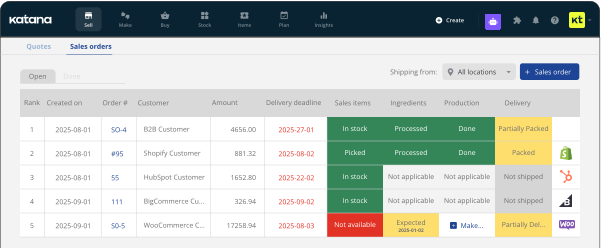
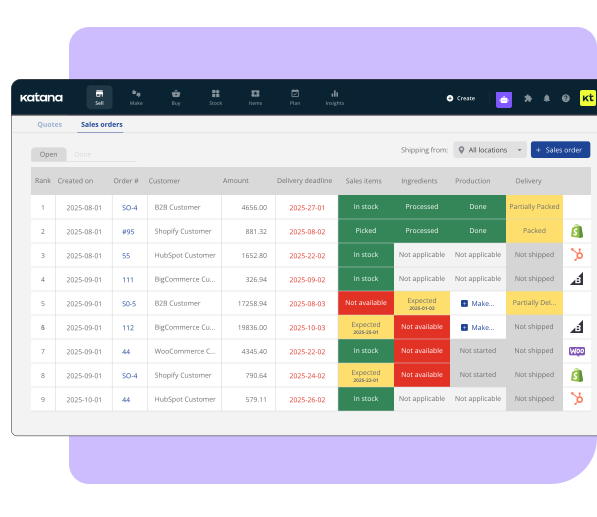
It keeps a real-time inventory record across Shopify, Amazon, WooCommerce, wholesale, and other channels. Orders from all channels feed into one queue. Fulfillment routes to the right location automatically. Stock levels update the moment an order is confirmed or a shipment received.
For brands moving toward omnichannel, Katana provides the inventory accuracy layer that any omnichannel system builds on. See Katana pricing for current plans.
Running multiple locations with separate spreadsheets?
Unify your inventory view. Katana shows every warehouse, every item, and every stock movement from one dashboard, with real-time sync between locations.
Explore Katana’s inventory capabilities
Frequently asked questions
Not necessarily — it depends on your business model and customer behavior. Omnichannel is more complex and expensive to build and maintain. For brands where customers shop across one or two channels without expecting a unified experience, multichannel inventory management delivers most of the operational benefit at a fraction of the infrastructure cost. Omnichannel adds value when customers genuinely move between channels as part of one journey.
No. A Shopify + Amazon business needs multichannel inventory sync — accurate stock across both channels in real time. That’s a multichannel problem, not an omnichannel one. Omnichannel becomes relevant if you add a physical retail location where customers expect to return Amazon or Shopify orders in person, or if you’re building a loyalty program that spans all three.
Some platforms grow with you; others have a ceiling. The inventory and order management layer typically extends to omnichannel well — shared stock records and fulfillment routing apply in both models. What changes is the customer experience layer: unified carts, loyalty, and cross-channel service. These usually require additional tools (a CDP, a loyalty platform, an omnichannel POS) that sit alongside your inventory system rather than replacing it.
Trying to build omnichannel before multichannel operations are stable. If your inventory isn’t accurate across channels, a unified customer experience makes the problem more visible, not smaller. Get real-time inventory sync working first. Then consider whether omnichannel infrastructure is worth the investment for your specific customer base.
If you’re selling across more than one channel and still managing stock manually or in spreadsheets, get started with a free Katana plan to see how real-time multichannel inventory management works in practice.
See all your locations from one screen
Start free with Katana. Set up your warehouses, track stock movements, and manage transfers — all from one dashboard with real-time sync.